NCCCO Tower Crane · Brickell to Water Street to St. Pete
Tower Crane Certification Prep for Florida's High-Rise Crews
Tower cranes in Florida cluster where land is expensive and buildings climb: Brickell and downtown Miami, Las Olas in Fort Lauderdale, Tampa's Water Street district, downtown St. Petersburg, and the growing skylines around Orlando and West Palm Beach. Most of those masts go up beside a coastline, which means the operator works with sea breezes all year and hurricane threats for half of it.
Tower cranes need their own certification separate from mobile cranes. This course prepares you for the NCCCO Tower Crane Operator written exam, at your own pace, so you can focus your hands-on time on the practical.
Topics in this prep
- Radius tables for trolley jibs and luffing booms, and how jib length changes them
- Out-of-service wind settings, free slew and clearing the jib's swing path
- Moment and load limiters, trolley and hoist limits, and testing them each shift
- Radio discipline for lifts the cab cannot see, including on the far side of a core wall
- Overlapping swing zones when two or more cranes share a tight downtown lot
- Storm preparation tasks contractors assign before a named system arrives
- Foundations, ties to the structure and what operators should notice during a climb
- OSHA 1926.1435 and related Subpart CC sections that apply to tower cranes
What two Florida storms taught the industry
When Hurricane Irma reached South Florida in September 2017, two tower crane booms failed over downtown Miami, including one at 300 Biscayne Boulevard. City officials said at the time that the cranes had been built for winds around 145 mph and that taking one down or relocating it takes about two weeks, which is why they stayed up as the storm approached. Seven years later, during Hurricane Milton in October 2024, a tower crane boom fell from the 400 Central tower under construction in downtown St. Petersburg. Nobody was hurt in that collapse.
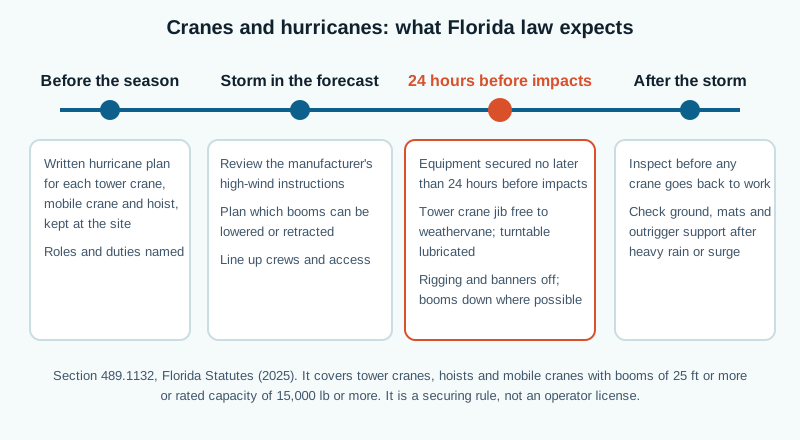
Those events shaped the state law that now applies. In 2025 the Legislature passed SB 180, creating s. 489.1132, Florida Statutes. When a tower crane is on a construction, demolition or excavation site, a hurricane preparedness plan for it, naming who does what, must be available for inspection. The contractor in control must secure the crane no later than 24 hours before hurricane impacts are expected, following the manufacturer's high-wind recommendations. The statute mentions examples such as letting the jib weathervane, removing rigging and banners, and lubricating the turntable. The Florida Building Commission is also working on best practices for tower cranes in hurricane season, with a report due by the end of 2026.
How the NCCCO tower crane credential is structured
There is no Core-plus-specialty split here. You take one written exam, which NCCCO lists at 55 multiple-choice questions with 60 minutes allowed, and one practical. The practical is where configuration shows up on your card: hammerhead (a flat or saddle jib with a trolley), luffing jib, or self-erecting. You can sit the two exams in either order, and once one is passed you have 12 months to pass the other.
Eligibility also includes being at least 18, following NCCCO's substance abuse policy and agreeing to its code of ethics. A card lasts five years.
Picking the practical that matches your next job
Luffers are common on Florida's tightest lots, where a horizontal jib would swing over a neighboring tower, an occupied street, or airspace near a hospital helipad. Hammerheads dominate open sites and big podium jobs. Self-erectors show up on mid-rise apartments and smaller commercial work, where they can stay for months without blocking a lane the way a parked mobile crane would. Test on the configuration your contractor actually runs; you can add another one later through its practical.
Inside the course
Lessons start with machine types and terminology, then move into radius tables, counterweight and ballast concepts, limiting devices, signals and radio procedures, and the Subpart CC sections specific to tower cranes, including pre-erection checks and foundation and structural support requirements. A separate lesson covers wind: the in-service limit on your crane's documentation, how to read anemometer data in the cab, and what the out-of-service condition looks like in practice.
Online study prepares you for the written exam only. The hands-on test is given by an accredited practical examiner, and your employer still has to evaluate you on the specific crane before you run it on their project.
- Self-paced lessons on any device, 24/7
- Practice questions in the style of the written exam
- Chart drills by jib length and trolley or hook radius
- Storm and wind procedures tied to Florida conditions
Questions people ask
Does Miami-Dade still require its own tower crane operator certification?
No. Miami-Dade adopted a crane ordinance in 2008, but federal courts found much of it preempted by the OSH Act, and a 2012 state law preempted local hoisting equipment rules. Today the operator requirement comes from federal OSHA Subpart CC, which is met with accredited certification such as NCCCO plus an employer evaluation.
Who secures the tower crane before a hurricane, the operator or the contractor?
Florida law places the duty on the contractor in control of the site. In practice the operator and erection crew usually carry out the steps in the plan, so knowing the manufacturer's high-wind procedure is part of the job.
Will my NCCCO mobile crane card cover a tower crane?
No. Tower cranes are certified separately. You need the tower crane written exam and a practical on the configuration you plan to run.
Is lightning a bigger issue in a tower cab?
It is a serious one anywhere in Florida, which leads the nation in lightning deaths according to the National Weather Service. Follow your employer's stop-work and evacuation rules and the manufacturer's guidance; the course discusses how weather decisions fit the operator's role.
Local pages that recommend this course
Exam prep courses
-
Mobile Crane Operator
Online prep for the NCCCO mobile crane written exams, the Core plus the LAT, TLL or TSS specialty you plan to test in, framed around Florida ground, weather and job types.
-
Rigger Level I
Self-paced prep for the NCCCO Rigger Level I written exam, covering sling and hardware inspection, basic hitches, connections and knots, with Florida examples from ports, high-rises and industrial plants.
-
Signalperson
Online prep for the NCCCO Signalperson written exam, covering the standard hand signals, voice and radio signaling, crane movements and the OSHA rules on when a signal person is needed.
-
Articulating Crane Operator
Prep online for the NCCCO articulating crane written exam that fits your truck, whether a standard knuckleboom, a winch-equipped unit or a grapple loader, with Florida delivery conditions in mind.
-
Service Truck Crane Operator
A focused course for techs who run the crane on a mechanics' body: get ready for the NCCCO TSS-STC written exam, then take a practical built for remote and pendant controls.
-
Digger Derrick
Self-paced study for the NCCCO Digger Derrick Operator written exam, written around Florida distribution work, hurricane restoration and the point where a line truck becomes a crane under OSHA.
-
Rigger Level II
Online prep for the NCCCO Rigger Level II written exam, focused on estimating weights, finding centers of gravity, picking rigging components and laying out lifts on Florida ports, high-rises and plants.
-
Mobile Crane Recertification
A self-paced refresher for Florida operators whose NCCCO mobile crane card is coming due: the recert written exams, how practical-exam hours are counted, and scheduling around storm season.
Line up your Florida crane exam prep today
Send a few details: the card you need, the equipment you run and the part of Florida you work in. An enrollment advisor writes back with a matching course and a plan for getting your written and hands-on exams on the calendar.
- Self-paced lessons that open on a phone, tablet or laptop
- Practice questions written in the style of the NCCCO tests
- Pointers on finding a practical test site near your county
Ask about enrollment
A short form. Your details are used only to reply to you.