Career path · From groundhand to certified operator
How to Become a Crane Operator in Florida
Nobody walks onto a Florida job site and gets handed the keys to a 90-ton hydraulic crane. Operators get there in stages: they start on the ground, learn how loads behave, earn trust from a lift supervisor, log hours under a qualified trainer, and then pass the exams for a nationally accredited certification. The order varies from person to person, but the stages rarely get skipped.
This page lays out those stages as a practical sequence, from the first entry-level job to adding specialties years later. The legal side, such as why Florida has no state crane license and what the 2025 hurricane statute asks of contractors, is covered separately in our Florida crane certification requirements guide.
Step one: get hired near the crane
The fastest way to learn cranes is to work next to one every day. Most operators began in a support role, and each of these entry points teaches something the seat will demand later.
- Oiler or apprentice operator. On larger cranes, an oiler greases, fuels and inspects the machine, helps with assembly, and watches the operator work. It is the traditional apprenticeship seat and the closest view of how lifts are planned and run.
- Rigger or signal person. Hooking loads, choosing slings and giving signals teaches load weights, center of gravity and communication with the cab. Many Florida contractors want a rigger or signalperson card before they will put someone through operator training.
- Boom truck or delivery driver. Building-supply yards, truss and block suppliers, and HVAC distributors run boom trucks and knuckle-boom delivery cranes. A driver who already holds a commercial license can learn to set outriggers and place loads, then pursue a fixed-cab boom truck or articulating crane card.
- Equipment yard or rental shop work. Mechanics' helpers and yard hands at crane rental and service companies learn machines from the inside: hydraulics, wire rope, load moment indicators and pre-shift inspections.
- Military experience. Engineer units and the Navy Seabees' Equipment Operator rating run cranes and heavy equipment. Veterans often arrive with real seat time, though a military qualification is not the same thing as an accredited civilian certification, so plan on testing.
Step two: pick a training route
Once you are on the ground crew, you need structured training to move up. Florida has three common routes, and many operators blend them.
- Union apprenticeship. The International Union of Operating Engineers represents crane operators, oilers, mechanics, riggers and signal people. In South Florida that is IUOE Local 487, which runs an apprenticeship covering heavy equipment including cranes through a joint training fund with signatory employers. IUOE apprenticeships are earn-while-you-learn: apprentices work at a reduced wage rate that steps up as they gain skills, alongside classroom and yard training. Openings, eligibility and application windows are set by the local, so check with it directly.
- Open-shop employer training. Many Florida contractors, crane rental firms and utilities are non-union and grow operators in-house. A typical pattern is ground crew first, then supervised time in the seat with a qualified trainer, then company-paid certification testing once the operator is ready.
- NCCER craft training. NCCER publishes a three-level Mobile Crane Operations curriculum, offered through training sponsors, contractor associations and some colleges. It covers rigging, crane operation, boom assembly and disassembly, load dynamics and lift planning. NCCER also runs a separate accredited crane operator certification, distinct from its training modules.
Step three: build seat time the right way
Book knowledge gets you through the written exams. Running a crane smoothly, with a load swinging at the end of 100 feet of line, only comes from hours at the controls. That is what the practical exam measures and what your future employer will judge.
Federal OSHA lets a person who is not yet certified run equipment as an operator-in-training, but only under tight conditions: a qualified trainer or experienced operator must continuously monitor them and be able to communicate with them, and certain tasks, such as lifts near power lines, multiple-crane lifts and hoisting personnel, are off limits. Ask your supervisor to set this up formally so your hours count and you stay inside the rule.
Keep your own log from day one. Write down the machine, configuration, capacity, the kind of work and the hours. That record helps when a new employer asks about your experience, and later, NCCCO recertification looks at crane-related hours during the five-year certification period.
Step four: choose your first certification
Your first card should match the crane you actually run, or will run soon, not the biggest machine you can imagine. NCCCO organizes mobile crane certification by specialty, and a first-time candidate takes the core written exam plus one or more specialty exams.
- TSS (telescopic boom, fixed cab): boom trucks and similar machines where the operator rides in the truck cab or a fixed station. A common first card for delivery and sign-erection work.
- TLL (telescopic boom, swing cab): rough-terrain, all-terrain and truck cranes with a cab that rotates with the upper. This covers much of the hydraulic crane work on Florida commercial and road jobs.
- LAT (lattice boom): crawlers and truck-mounted lattice cranes. Usually added after time on hydraulics, often by operators heading toward bridge, port or heavy industrial work.
- Narrower cards: service truck cranes (STC), articulating cranes and digger derricks each have their own exams (fixed-cab boom trucks fall under TSS since NCCCO retired the BTF exam in 2021) for people whose work is limited to that equipment.
Step five: meet eligibility, then pass the written and practical exams
NCCCO candidates must be at least 18 and must agree to NCCCO's substance abuse policy and code of ethics. Since January 1, 2020, NCCCO no longer requires a medical examination to be eligible to test. The physical requirements in the ASME B30 standards still apply on the job, and NCCCO left it to employers, who know the crane and the work, to confirm that an operator meets them. Some employers accept a DOT medical card as part of that check.
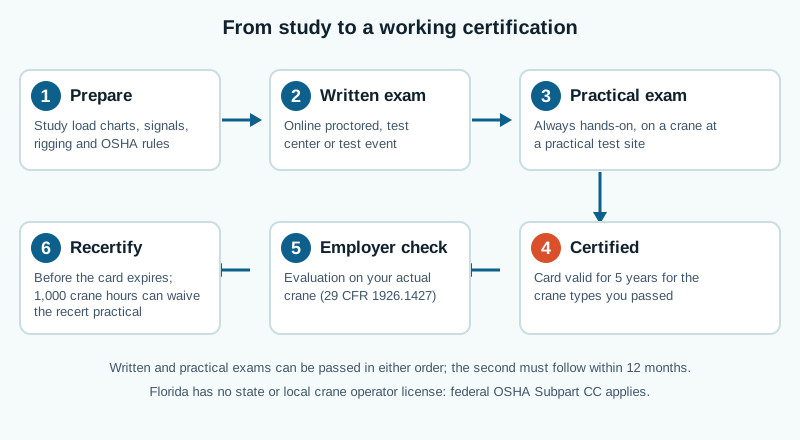
Most candidates take the written exams first, while the material is fresh, and then book the practical once they have enough seat time. NCCCO allows either order, but you have 12 months after passing the first exam to pass the matching one for the same designation, or the earlier result no longer counts.
The written exams can be taken through online proctoring, at a test center or at a scheduled test event. The practical is run on a real crane at a practical test site with an accredited examiner watching. Prepare for the written side with self-paced study, such as our Mobile Crane Operator course, and prepare for the practical in the seat.
Step six: pass the employer evaluation
A certificate in your wallet is not the finish line. Under 29 CFR 1926.1427, the company that puts you on a crane has to evaluate you on the equipment you will actually operate and the work you will actually do, then document it. OSHA began enforcing the evaluation and documentation requirement on February 7, 2019.
Expect the evaluator to watch you perform a pre-operation inspection, set up on the ground and mats you are given, read the chart for the configuration in use, and make real or simulated picks. The evaluation covers things a national exam cannot, such as the specific load moment indicator, the attachments on that machine, and how the crew communicates on that job. Every new employer runs its own evaluation, so treat each one as a fresh audition.
Step seven: add specialties and stay current
After a year or two on one type of machine, operators usually widen their range. Common next steps are adding TLL to a TSS card, adding LAT to run crawlers, picking up Rigger Level II for more complex rigging, or moving toward tower crane work on high-rise jobs with a tower crane certification. Each added specialty means another written exam and another practical for that equipment.
Certification runs five years. Plan the renewal in the final year: retake the specialty written exams, and if you have logged enough crane-related hours, the recertification practical can be waived. The Mobile Crane Recertification course is built for that review.
Questions people ask
Do I need a commercial driver's license to become a crane operator?
Not for certification itself. NCCCO does not require a CDL. Many Florida employers want one anyway, because truck cranes and boom trucks travel public roads between jobs, and some apprenticeship programs list a CDL among their entry requirements. Check the specific job or program.
Can I take the practical exam before the written exams?
NCCCO allows either order. You must pass the matching exam within 12 months of passing the first one for the same designation. Most people do the written exams first so they are not rushing to cram after a practical.
Do I need a medical exam to sit for NCCCO testing?
Not to be eligible. NCCCO dropped the medical evaluation from its eligibility requirements effective January 1, 2020. Employers are still expected to confirm operators meet the physical requirements in the ASME B30 standards, so your employer may ask for a physical or a DOT medical card.
Is joining the union the only way in?
No. Union apprenticeship through the Operating Engineers is one route. Many Florida operators come up through non-union contractors, crane rental companies and utilities that train in-house and pay for certification. Both paths end at the same accredited exams and employer evaluation.
Can an online course make me a crane operator?
No. Our courses are self-paced prep for the written exams, with practice questions and exam-style material on any device, 24/7. Seat time, the hands-on practical exam and your employer's evaluation all happen in person on real equipment.
Prep that matches this work
-
Mobile Crane Operator
Online prep for the NCCCO mobile crane written exams, the Core plus the LAT, TLL or TSS specialty you plan to test in, framed around Florida ground, weather and job types.
-
Rigger Level I
Self-paced prep for the NCCCO Rigger Level I written exam, covering sling and hardware inspection, basic hitches, connections and knots, with Florida examples from ports, high-rises and industrial plants.
-
Signalperson
Online prep for the NCCCO Signalperson written exam, covering the standard hand signals, voice and radio signaling, crane movements and the OSHA rules on when a signal person is needed.
-
Service Truck Crane Operator
A focused course for techs who run the crane on a mechanics' body: get ready for the NCCCO TSS-STC written exam, then take a practical built for remote and pendant controls.
Line up your Florida crane exam prep today
Send a few details: the card you need, the equipment you run and the part of Florida you work in. An enrollment advisor writes back with a matching course and a plan for getting your written and hands-on exams on the calendar.
- Self-paced lessons that open on a phone, tablet or laptop
- Practice questions written in the style of the NCCCO tests
- Pointers on finding a practical test site near your county
Ask about enrollment
A short form. Your details are used only to reply to you.