Federal OSHA · Subpart CC · s. 489.1132 F.S.
Florida Crane Certification Requirements, Explained Plainly
Florida runs no crane operator licensing program of its own, and no Florida county or city issues a crane card either. The rules a Florida operator actually works under come from Washington: federal OSHA's cranes and derricks standard, 29 CFR 1926 Subpart CC, which calls for accredited certification plus an evaluation by your employer before you run a machine on a construction job.
Layered on top of that is something unusual for this state: since 2025, a Florida statute tells contractors how to get tower cranes, mobile cranes and hoists ready before a hurricane. This guide walks through who enforces what, how Miami-Dade once tried to write its own crane code and lost, what the 2025 hurricane law requires on site, and how the written and hands-on exams fit together. For quick answers, see the FAQ.
Who polices crane work in Florida
Florida never adopted an OSHA-approved State Plan. That means the federal agency itself inspects private-sector job sites here and writes the citations when a lift goes wrong. Florida's OSHA area offices sit in Fort Lauderdale, Jacksonville, Tampa and Orlando, and a handful of counties at the western end of the Panhandle are covered from OSHA's Mobile, Alabama area office.
There is a gap worth knowing about. Federal OSHA does not cover state, county or municipal employees, and because Florida has no State Plan, there is no state agency stepping in to cover them the way plans in other states do. A city utility crew running a boom truck is outside federal OSHA jurisdiction. Many public employers still require certification by policy or contract, and a public owner can write it into bid documents, so do not read the gap as permission to skip training.
For everyone working for a private contractor, rental house or service company, Subpart CC is the rulebook. It applies to construction work with cranes and derricks, including mobile hydraulic cranes, lattice crawlers, tower cranes, boom trucks, and many articulating knuckle-boom units.
No state card, but Subpart CC still applies
NCCCO keeps a public list of the states and cities that license crane operators. Florida is not on it, and neither is Miami, Tampa, Orlando, Jacksonville or any other Florida jurisdiction. You will not find a crane license application at the Department of Business and Professional Regulation or at a county building department.
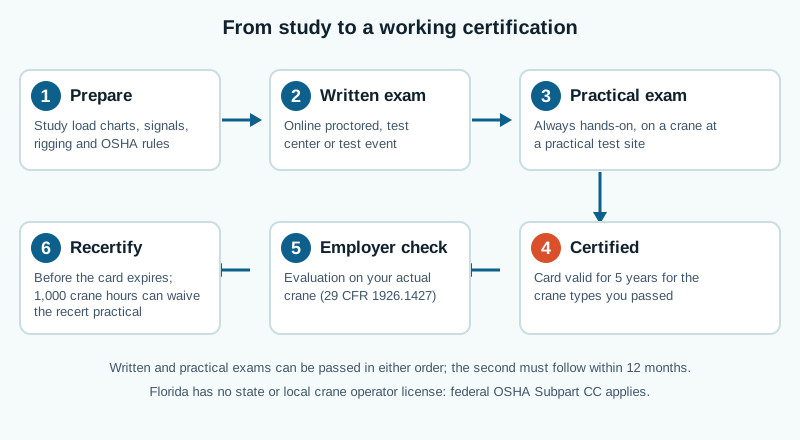
What 29 CFR 1926.1427 requires instead is a two-part qualification. First, the operator holds a certification from a testing organization accredited by a nationally recognized accrediting agency, earned by passing a written and a practical exam for the type of equipment being run. NCCCO is the best-known option; CIC, NCCER and OECP are among the other accredited bodies. Second, the employer evaluates the operator on the specific machine and the work at hand, and documents that evaluation. The certificate proves general knowledge and skill. The evaluation proves you can run this crane, with this configuration, on this job.
Operators-in-training can run equipment under the conditions set in the standard, which include continuous monitoring by a qualified trainer and limits on the kind of work they may do. The certificate is portable between Florida employers. The employer evaluation is not; a new employer has to do its own.
- Certification: accredited, by equipment type, with written and practical exams.
- Employer evaluation: done by the company, specific to the machine and tasks, kept on file.
- Retraining: required when an evaluation shows a gap or the operator moves to unfamiliar equipment.
Signal people, riggers and power lines
A crane crew is more than the person in the cab. Under 1926.1428, anyone giving signals must be qualified, either through a third-party qualified evaluator or the employer's own qualified evaluator. A signal person has to know the standard hand signals, understand basic crane operation and limits, and demonstrate competence in an oral or written test plus a practical test. The employer keeps documentation of the qualification available at the site.
Riggers are addressed in 1926.1425 and the definitions in 1926.1404. When workers are within the fall zone while hooking, unhooking or guiding a load, and during assembly and disassembly work, the rigging must be done by a qualified rigger. OSHA does not demand a third-party rigger card, but a written and practical rigger certification is the cleanest way for a contractor to show who on the crew is qualified.
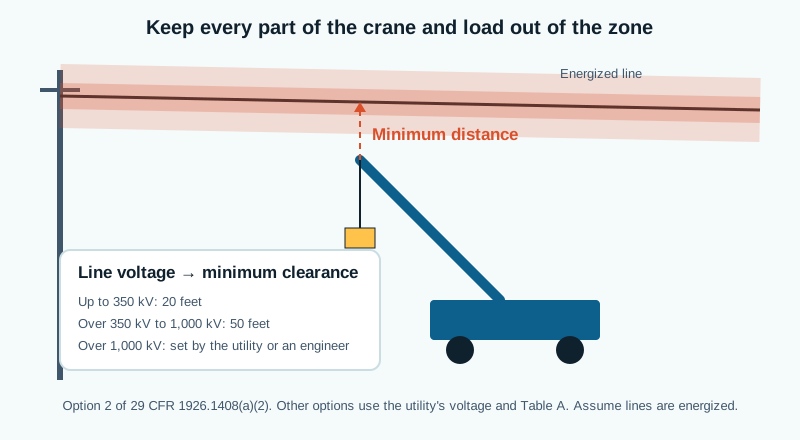
Contact with overhead lines is one of the deadliest crane hazards, and Florida has a lot of overhead distribution running along road shoulders and canal banks. Section 1926.1408 makes the employer identify the work zone, determine whether any part of the crane, load line or load could get within 20 feet of a line rated up to 350 kV, and then either de-energize and ground, keep the 20-foot clearance, or follow the minimum-distance table with additional protective measures such as a dedicated spotter.
Hoisting workers on a crane is restricted too. Under 1926.1431, personnel hoisting is allowed only when the employer shows that conventional access such as a scaffold, aerial lift or stairway would be more dangerous or is not possible. When it is used, the load generally cannot exceed half the rated capacity at that radius and configuration, a trial lift with the empty platform comes first, and a pre-lift meeting is held.
How Miami-Dade's crane ordinance was taken off the books
In 2008 Miami-Dade County adopted Ordinance 08-34, creating Chapter 8E of the County Code, "Cranes and Hoisting Equipment." It set wind-design criteria for tower cranes, called for local operator certification and laid out hurricane-preparedness duties for contractors. It was the most aggressive local crane rule in the state.
Contractor groups challenged it in federal court. The court found that much of the ordinance was preempted by the federal Occupational Safety and Health Act, because it regulated the same workplace hazards that federal OSHA already governs, and the Eleventh Circuit affirmed in 2010 in Associated Builders & Contractors Florida East Coast Chapter v. Miami-Dade County, 594 F.3d 1321.
The hurricane-preparedness pieces survived that lawsuit, but not for long. In 2012 the Legislature passed HB 521 (Chapter 2012-62, Laws of Florida), creating s. 489.113(11), F.S., which reserves to the state the regulation of construction hoisting equipment and wipes out local rules on the subject, including local worksite hurricane plans. Today neither Miami-Dade, Broward, the City of Miami nor any other Florida local government runs its own crane operator certification or crane hurricane ordinance.
The 2025 hurricane law for cranes and hoists
After years of preemption with no state-level storm rule to replace the local ones, the Legislature filled the gap. SB 180, signed June 30, 2025, created s. 489.1132, F.S., titled "Regulation of hoisting equipment used in construction, demolition, or excavation work during a hurricane."
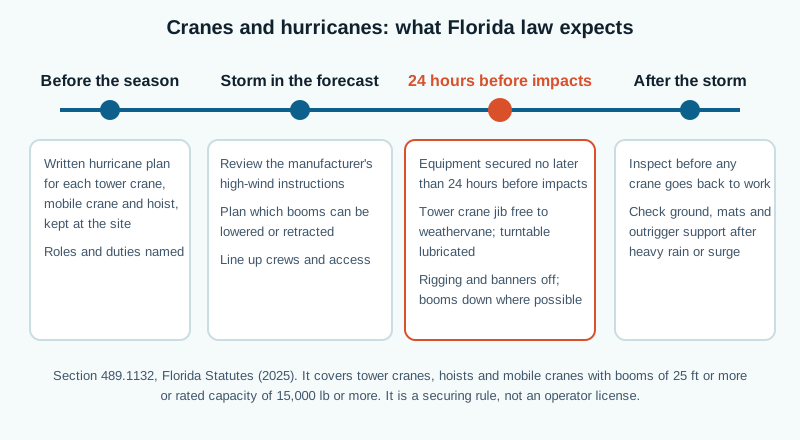
The law does not create an operator license and does not change who may sit in the seat. It puts duties on the contractor in control of the worksite whenever a tower crane, mobile crane or hoist is on site. For purposes of the statute, a mobile crane does not include one with a boom shorter than 25 feet or a rated capacity below 15,000 pounds, so small carry-deck and light picker units fall outside it.
The Florida Building Commission was told to develop best practices for tower cranes and other hoisting equipment during hurricane season and to report to the Legislature by December 31, 2026. Draft and interim material circulated during 2026; watch for the final report, since it may lead to further rulemaking or legislation.
- A written hurricane preparedness plan for the hoisting equipment must be available for inspection at the site, naming who is responsible for each step.
- Equipment must be secured no later than 24 hours before hurricane impacts are anticipated.
- Securing follows the manufacturer's high-wind recommendations: for example, letting a tower crane weathervane, lowering or retracting booms where possible, stripping rigging and banners, and lubricating tower-crane turntables.
- Hurricane season runs June 1 through November 30, so plans should be in place before June on any job with a crane on site.
Why the storm rule exists: Irma and Milton
On September 10, 2017, as Hurricane Irma raked South Florida, the booms of two tower cranes failed in downtown Miami, one of them at 300 Biscayne Boulevard. City officials said the cranes were designed to handle winds of about 145 mph and that taking one down or relocating it is roughly a two-week job, which is why cranes generally ride out storms in place rather than being removed.
In October 2024, Hurricane Milton broke the boom off a tower crane at the 400 Central tower under construction in downtown St. Petersburg. Nobody was hurt. Both failures put a spotlight on what is done in the days before landfall, which is exactly what s. 489.1132 now addresses.
For an operator, the practical takeaway is that storm prep is now a documented duty with a deadline. Know your machine's high-wind procedure, know who on the plan owns each task, and expect to be asked to finish securing work well ahead of the first tropical-storm-force gusts.
Phosphate mines and other places Subpart CC does not reach
Central Florida's phosphate mines, in Polk, Hardee, Hillsborough and Manatee counties, fall under the federal Mine Safety and Health Administration rather than OSHA. MSHA has its own training and equipment rules, and the Subpart CC operator certification requirement does not govern lifts on mine property. Mine operators and their contractors frequently ask for NCCCO certification anyway, so crane people moving between mine work and construction often carry it.
Some construction equipment is partly or wholly outside Subpart CC. Digger derricks used by electric and telecom utilities to auger holes and set poles have a limited exemption under 1926.1400(c)(4) when the work is covered by Subpart V; setting a pad-mount transformer or other non-pole work does not qualify. Articulating cranes delivering materials to a site can fall under the 1926.1400(c)(17) exclusion in some situations, but that exclusion ends the moment the crane holds a load for a structural assembly or uses certain attachments. When in doubt, certify.
Written test, practical test and renewal
NCCCO written exams can be taken through Online Proctored Testing from a suitable computer, at a computer-based test center, or at scheduled test events. The written core exam and the specialty exams for your crane type, such as LAT (lattice boom), TLL (telescopic boom, swing cab) or TSS (telescopic boom, fixed cab), have to be passed within the set window before certification is issued.
The practical exam is always hands-on, on a real crane, at a practical test site under an accredited examiner. No online course replaces it. Most candidates schedule the practical through a test site or training provider that has the right crane, and many employers set up practical sessions for their own crews.
Certification lasts five years. To recertify you retake the specialty written exams during the last 12 months before expiry. The recertification practical can be waived if you document at least 1,000 hours of crane-related experience during the certification period. Let it lapse and you start over with both the written and the practical.
Our courses are self-paced online prep for the written exams: practice questions and exam-style material you can study on any device at any hour. They get you ready for the knowledge side. Seat time and the practical are still up to you and your employer. When you are ready, enroll here and an enrollment advisor will reply to your request.
Questions people ask
Do I need a Florida crane license to run a crane on a construction site?
No. Florida does not license crane operators, and no Florida city or county does either. What you need is accredited certification for the crane type, such as NCCCO, plus a documented evaluation by your employer under 29 CFR 1926.1427.
Does the 2025 hurricane law mean I need a new card?
No. Section 489.1132, F.S., is about securing tower cranes, mobile cranes and hoists before a storm and keeping a preparedness plan on site. It puts duties on the contractor in control of the job, not a licensing requirement on the operator.
I work for a county public works department. Does OSHA cover me?
Federal OSHA does not cover state or local government employees, and Florida has no State Plan to cover them. Your employer may still require certification by policy, and it remains the best evidence that you know the job.
Can I still run cranes in Miami-Dade with just my NCCCO card?
Yes. The county's 2008 operator certification rules were largely struck down as preempted by federal law, and the 2012 state law in s. 489.113(11) preempts local hoisting-equipment rules. The federal certification and employer evaluation requirements are what apply.
Does a phosphate mine accept the same certification?
Mines are under MSHA, not OSHA Subpart CC, so the federal crane certification rule does not apply there. Many mine operators and contractors require NCCCO certification on their own, so check with the site before you show up.
Prep that matches this work
-
Mobile Crane Operator
Online prep for the NCCCO mobile crane written exams, the Core plus the LAT, TLL or TSS specialty you plan to test in, framed around Florida ground, weather and job types.
-
Tower Crane Operator
Prepare for the single NCCCO tower crane written exam online, then test hands-on on a hammerhead, luffer or self-erector. Lessons lean into Florida wind, storms and congested urban sites.
-
Signalperson
Online prep for the NCCCO Signalperson written exam, covering the standard hand signals, voice and radio signaling, crane movements and the OSHA rules on when a signal person is needed.
-
Rigger Level I
Self-paced prep for the NCCCO Rigger Level I written exam, covering sling and hardware inspection, basic hitches, connections and knots, with Florida examples from ports, high-rises and industrial plants.
Line up your Florida crane exam prep today
Send a few details: the card you need, the equipment you run and the part of Florida you work in. An enrollment advisor writes back with a matching course and a plan for getting your written and hands-on exams on the calendar.
- Self-paced lessons that open on a phone, tablet or laptop
- Practice questions written in the style of the NCCCO tests
- Pointers on finding a practical test site near your county
Ask about enrollment
A short form. Your details are used only to reply to you.