NCCCO Core + LAT · TLL · TSS · Florida-focused study
Mobile Crane Operator Prep for Florida Hydro and Crawler Seats
A Florida mobile crane operator might spend Monday setting rooftop chillers in Doral, Wednesday flying precast on a parking garage in Lakeland, and Friday on a crawler feeding piling at a seawall rebuild on the Gulf coast. The machines change, but the federal requirement stays the same: on construction work covered by OSHA Subpart CC, the operator needs certification from an accredited body plus an evaluation from the employer. Florida adds no license of its own on top of that.
This course gets you ready for the written side of the most widely held credential, the NCCCO Mobile Crane Operator program. You study online at your own pace, on a phone or a laptop, and work through practice questions until the load chart problems stop feeling like guesswork.
Topics in this prep
- Bearing pressure on sand, muck and fill near retention ponds or seawalls
- Mat and pad sizing when the water table sits a few feet down
- Chart math: deductions for hook blocks, jibs, stowed attachments and line parts
- Radius, boom angle and over-side versus over-front capacity
- Subpart CC power line zones around FPL, Duke and co-op distribution feeders
- Gust limits, sail area and when an afternoon squall line means stop
- Lightning procedures and getting the crew clear of the hook
- RCL/LMI settings, configuration codes and what to do after a fault
- Signals, radio protocol and blind picks with a dedicated signal person
Florida ground is the first thing the exam tests you on
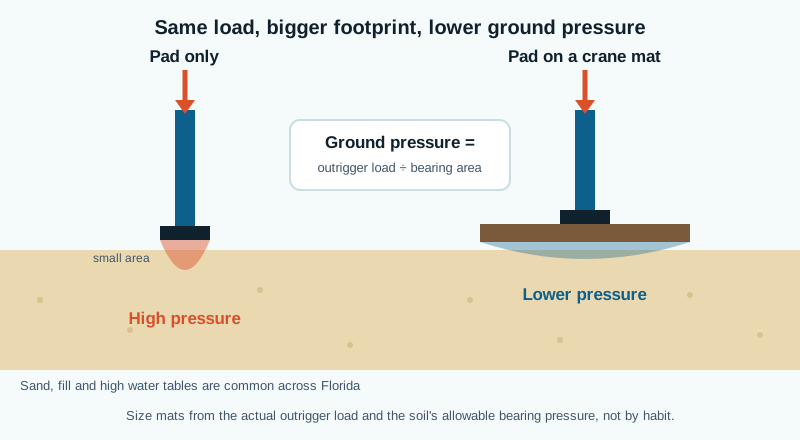
Much of peninsular Florida sits on sand over limestone, with groundwater close to the surface. A pad that looks firm at 9 a.m. can soften after an afternoon downpour, and fill placed next to a stormwater pond or behind a new seawall may not be compacted the way the site plan claims. Karst adds another wrinkle in parts of central and west-central Florida, where voids can sit under ground that looks perfectly ordinary.
That is why the Core exam's site and setup domain matters so much here. You need to be comfortable converting an outrigger reaction into a bearing pressure, choosing a mat or float large enough to bring it under what the soil can take, and recognizing when the answer is a geotechnical review rather than bigger cribbing. The course drills those calculations and the reasoning behind them.
Choosing between LAT, TLL and TSS
Everyone sits the Core. Then you pick at least one specialty that matches the machine. TLL fits the swing-cab hydros that do most of the daily picking across Florida metros: rough-terrains on tilt-wall warehouses along I-4, all-terrains on hotel and medical jobs. TSS fits fixed-cab telescopic cranes, which includes many boom trucks used by sign, HVAC and pool-enclosure contractors. LAT is the lattice boom specialty, the one crawler operators on bridge, port, power plant and launch-complex work tend to need. NCCCO retired the separate crawler and truck lattice codes into LAT, so an older card may still show LBC or LBT.
Operators often add a second specialty later as their work shifts. Each one is its own written exam and its own practical, and the course lets you study the specialty material separately from the Core.
Weather a Florida operator has to read correctly
Load charts assume calm air or a stated wind limit. Florida summers bring sea-breeze thunderstorms almost daily, and the gust front can arrive well before the rain. Large, light loads such as roof panels, glazing units, or signage catch that wind first. The Core expects you to know how wind reduces usable capacity and who is responsible for stopping the lift.
Florida also leads the country in lightning deaths, according to the National Weather Service. A raised steel boom is a poor place to be near when cells are building, and the crew on the tag lines is exposed too. The lessons cover practical stop-work triggers and how they connect to the manufacturer's instructions.
Then there is hurricane season, June 1 to November 30. Under s. 489.1132, Florida Statutes, a mobile crane on a construction, demolition or excavation site needs a hurricane preparedness plan available for inspection, and the contractor in control must secure it at least 24 hours before hurricane impacts are anticipated, following the manufacturer's high-wind guidance. The statute's mobile crane definition leaves out machines with a boom under 25 feet or a rated capacity under 15,000 pounds. It is a securing duty for contractors, not an operator license, but operators are usually the people lowering booms and pulling rigging when a storm is coming.
Salt air, wire rope and the daily walkaround
Cranes working near Port Everglades, JAXPORT, Port Tampa Bay or any barrier-island condo job breathe salt all day. Corrosion shows up in wire rope cores, on sheave pins and in electrical connectors for the rated capacity limiter. The exam asks about frequent and periodic inspections, rope removal criteria and what an operator must do when a deficiency is found. Coastal work gives you plenty of chances to practice spotting them.
From study to a card in your wallet
Online prep covers the written exams. NCCCO offers those through online proctored testing, at test centers, and at scheduled test events. The practical is always hands-on, given by an accredited examiner on a crane matching the specialty you want. Once you pass one part, you have a 12-month window to pass the other for that crane type.
- Decide which specialty fits the crane you run now
- Work through Core domains, then specialty chart problems
- Book the written exams with NCCCO
- Arrange seat time and schedule the practical
- Finish your employer's evaluation under 1926.1427 before solo work
Questions people ask
Is there a Florida crane operator license I need in addition to NCCCO?
No. Florida does not license crane operators, and no Florida city or county appears on NCCCO's list of licensing jurisdictions. Private construction employers fall under federal OSHA, which calls for accredited certification and an employer evaluation. Our Florida requirements guide walks through it.
Does the hurricane statute change what I need to be certified?
No. Section 489.1132 deals with having a hurricane plan on site and securing hoisting equipment before a storm. It does not create an operator credential. Your certification requirements still come from OSHA Subpart CC.
I run a crane at a phosphate mine. Does this apply?
Mines fall under MSHA, not OSHA's construction crane standard, so Subpart CC certification is not the rule there. Many mine operators and contractors still ask for an NCCCO card, and anyone who also works construction will need one.
Can I study on my phone between jobs?
Yes. The course is self-paced and works on any device, so you can pick up where you left off on a lunch break or at home.
Local pages that recommend this course
Exam prep courses
-
Rigger Level I
Self-paced prep for the NCCCO Rigger Level I written exam, covering sling and hardware inspection, basic hitches, connections and knots, with Florida examples from ports, high-rises and industrial plants.
-
Signalperson
Online prep for the NCCCO Signalperson written exam, covering the standard hand signals, voice and radio signaling, crane movements and the OSHA rules on when a signal person is needed.
-
Tower Crane Operator
Prepare for the single NCCCO tower crane written exam online, then test hands-on on a hammerhead, luffer or self-erector. Lessons lean into Florida wind, storms and congested urban sites.
-
Articulating Crane Operator
Prep online for the NCCCO articulating crane written exam that fits your truck, whether a standard knuckleboom, a winch-equipped unit or a grapple loader, with Florida delivery conditions in mind.
-
Service Truck Crane Operator
A focused course for techs who run the crane on a mechanics' body: get ready for the NCCCO TSS-STC written exam, then take a practical built for remote and pendant controls.
-
Digger Derrick
Self-paced study for the NCCCO Digger Derrick Operator written exam, written around Florida distribution work, hurricane restoration and the point where a line truck becomes a crane under OSHA.
-
Rigger Level II
Online prep for the NCCCO Rigger Level II written exam, focused on estimating weights, finding centers of gravity, picking rigging components and laying out lifts on Florida ports, high-rises and plants.
-
Mobile Crane Recertification
A self-paced refresher for Florida operators whose NCCCO mobile crane card is coming due: the recert written exams, how practical-exam hours are counted, and scheduling around storm season.
Line up your Florida crane exam prep today
Send a few details: the card you need, the equipment you run and the part of Florida you work in. An enrollment advisor writes back with a matching course and a plan for getting your written and hands-on exams on the calendar.
- Self-paced lessons that open on a phone, tablet or laptop
- Practice questions written in the style of the NCCCO tests
- Pointers on finding a practical test site near your county
Ask about enrollment
A short form. Your details are used only to reply to you.