Line trucks · Storm restoration · NCCCO DDO
NCCCO Digger Derrick Prep for Florida Pole Setters and Storm Crews
When a hurricane pushes through Florida, the trucks that roll in behind it are mostly bucket trucks and digger derricks. Snapped distribution poles get augered out, reset and re-framed, often in standing water and almost always on a deadline. Most of that pole work sits outside the OSHA crane standard. The trouble is that the same truck gets used for other lifts on the same day: a pad-mount transformer onto a slab, a bundle of conduit off a trailer, a light pole at a new subdivision entrance. Those lifts can pull the operator back under Subpart CC.
This course prepares you for the NCCCO Digger Derrick Operator written exam, which is the certification built for exactly that machine. You study online at your own pace, on a phone in the truck cab or a laptop at the staging yard, and you work through practice questions laid out the way the exam asks them.
Topics in this prep
- Truck setup on sand, muck, saturated shoulders and backfilled trenches
- Walk-around checks for the auger drive, pole claws, winch and dielectric boom section
- Reading capacity charts for pole handling versus general material lifts
- Drilling, setting and pulling poles without losing control of the stick
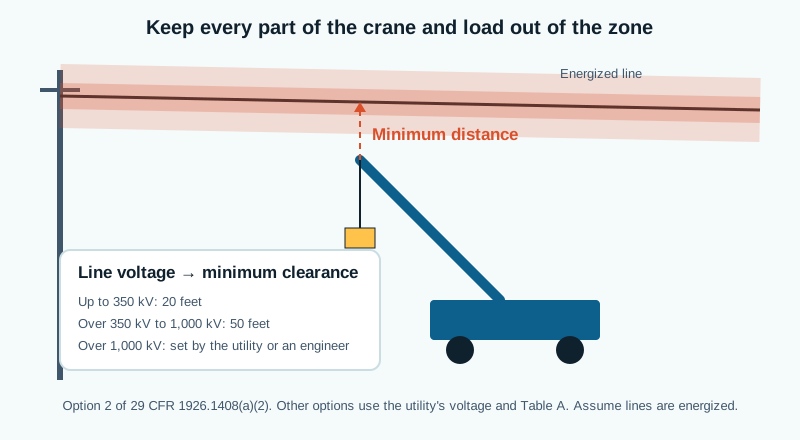
- Clearance from energized conductors during restoration after a storm
- How the 1926.1400(c)(4) carve-out is triggered by the task, not the employer
- Talking to the ground crew: hand signals, radios and job briefings
Pole work versus crane work: reading 1926.1400(c)(4)
Subpart CC leaves out a digger derrick when it is augering holes for electric or telecom poles, placing or removing those poles, or handling the materials that get mounted on or taken off them, as long as that work is done under Subpart V (power transmission and distribution) or 1910.268 (telecommunications). Outside that list, the derrick is treated like any other crane on a construction site.
In practice the question is asked one lift at a time. Setting a 45-foot pole on a feeder repair is excluded. Picking a transformer and landing it on the ground at a new commercial site is not, even though the same crew and truck did both before lunch. A utility logo on the door does not change the answer. When the derrick crosses into crane work, OSHA's 1926.1427 rules apply: the operator needs accredited certification for that type of equipment, and the employer has to evaluate the operator on the machine.
What the written test spends its questions on
NCCCO splits the 75-question written exam into five domains. Operation is the biggest at roughly 36 percent. Technical Knowledge is about 19 percent, Pre-Operation and Manufacturers' Load Charts are about 17 percent each, and Site is about 11 percent. You get 90 minutes, and you can sit it through online proctoring, at a test center, or at a scheduled test event.
Experienced line hands usually find Operation familiar and lose points on charts and site questions. The Site domain asks about voids, loose fill, slopes, excavations, drainage and overhead hazards, which is a fair description of a Florida roadside after a storm surge. Load chart questions want you to read capacity by radius and boom angle and to know when a chart note or deduction changes the number.
Florida ground and weather from the operator's seat
- Sand and high water tables: outrigger pads can sink into wet sand or muck, so pads, mats and a second look after the first lift matter more here than on firm clay.
- Augering below the water line: holes in low-lying areas can fill and cave quickly, which affects how long the auger stays in and how the pole is stabilized while it is backfilled.
- Limestone close to the surface: in parts of South Florida and the Keys the auger may meet rock within a few feet, changing torque, tooth wear and how the truck reacts.
- Afternoon lightning: summer thunderstorms build fast across the peninsula, and a raised boom near energized lines is the wrong place to be when a cell moves overhead. Crews stand down and wait it out.
- Salt air: trucks working coastal routes see faster corrosion on winch line, pins and pole claw hardware, which is why the pre-operation domain deserves real study.
The seven-task practical
The practical is taken in person on a digger derrick, with an NCCCO examiner watching. It opens with a briefing and up to ten minutes to get comfortable with the machine. The first task is a verbal pre-operation inspection: the examiner points to five checklist items and you explain, in about a minute each, how you would check it and what defects you would look for. Later tasks have you control a load, dig a hole and place a pole in sequence.
You can sit the written and the practical in whichever order your schedule allows. Once you pass the first one, a 12-month clock starts for the other. Online study prepares you for the written test and for the inspection talk; it cannot give you seat time on the controls, so plan practice runs on your company's truck before test day.
Studying between storms
Restoration work does not run on a class schedule. The course is self-paced and works on any device, so you can pick it up during a slow week in the yard or between mutual-aid assignments. Each domain is broken into short lessons with practice questions you can repeat. Supervisors can enroll a whole crew at once through the enrollment form, and an advisor replies to each request. For a wider view of what Florida requires and what it does not, read the Florida certification requirements guide.
Questions people ask
Does Florida issue its own license for line truck operators?
No. Florida has no state crane operator license, and federal OSHA covers private employers here. Certification requirements come from Subpart CC when a digger derrick is doing crane work.
We only replace storm-damaged distribution poles. Is certification optional for us?
That pole work falls under the 1926.1400(c)(4) exclusion when it is done under Subpart V or 1910.268. Many contractors certify operators anyway, because the same trucks often get used for transformer drops and material lifts that are not excluded.
Will this card let me run a boom truck or a mobile crane?
No. The NCCCO Digger Derrick Operator certification covers digger derricks only. Boom trucks and other mobile cranes have their own NCCCO certifications, such as the service truck crane or mobile crane programs.
Does a calculator come with the written exam?
NCCCO has supplied basic calculators for several written exams, including Digger Derrick Operator. Confirm the current rule for your test method when you register.
Local pages that recommend this course
Exam prep courses
-
Mobile Crane Operator
Online prep for the NCCCO mobile crane written exams, the Core plus the LAT, TLL or TSS specialty you plan to test in, framed around Florida ground, weather and job types.
-
Rigger Level I
Self-paced prep for the NCCCO Rigger Level I written exam, covering sling and hardware inspection, basic hitches, connections and knots, with Florida examples from ports, high-rises and industrial plants.
-
Signalperson
Online prep for the NCCCO Signalperson written exam, covering the standard hand signals, voice and radio signaling, crane movements and the OSHA rules on when a signal person is needed.
-
Tower Crane Operator
Prepare for the single NCCCO tower crane written exam online, then test hands-on on a hammerhead, luffer or self-erector. Lessons lean into Florida wind, storms and congested urban sites.
-
Articulating Crane Operator
Prep online for the NCCCO articulating crane written exam that fits your truck, whether a standard knuckleboom, a winch-equipped unit or a grapple loader, with Florida delivery conditions in mind.
-
Service Truck Crane Operator
A focused course for techs who run the crane on a mechanics' body: get ready for the NCCCO TSS-STC written exam, then take a practical built for remote and pendant controls.
-
Rigger Level II
Online prep for the NCCCO Rigger Level II written exam, focused on estimating weights, finding centers of gravity, picking rigging components and laying out lifts on Florida ports, high-rises and plants.
-
Mobile Crane Recertification
A self-paced refresher for Florida operators whose NCCCO mobile crane card is coming due: the recert written exams, how practical-exam hours are counted, and scheduling around storm season.
Line up your Florida crane exam prep today
Send a few details: the card you need, the equipment you run and the part of Florida you work in. An enrollment advisor writes back with a matching course and a plan for getting your written and hands-on exams on the calendar.
- Self-paced lessons that open on a phone, tablet or laptop
- Practice questions written in the style of the NCCCO tests
- Pointers on finding a practical test site near your county
Ask about enrollment
A short form. Your details are used only to reply to you.